


Stop living within the lie. I was in Davos when one of the most consequential speeches of our time was delivered. Prime Minister Mark Carney essentially said the quiet part out loud: the world order as we knew it no longer exists, and it would be foolish to pretend otherwise. We can pretend systems are intact. Or build for the world we’re actually in.
The truths as we start 2026:
A sitting G7 head of state just laid the intellectual scaffolding for mobility for individuals, without ever using the words “citizenship by investment”. Geopolitics is now a mainstream part of strategic planning for… everyone.
Private markets = where the action (and value for investors) is.
Innovator’s Dilemma from ‘97 is still relevant to AI + corporate adoption.
AI bots are gossiping about us, humans, on a new social network only for AI.
Hedging against uncertainty applies at every scale: national strategy, corporate innovation and individual life design.
Personally, I’m feeling less discombobulated after a necessary holiday rest. Perfectly timed, before being thrown into the turbulence of 2026.
Systems, Signals & Mental Models
🧠 Themes or frameworks I’ve been sitting with… from macro trends to micro reflections.
Canadian PM Mark Carney gave what I genuinely believe will go down as a historic speech.
Carney said plainly:
The old order is not coming back. We should not mourn it. Nostalgia is not a strategy.
For decades, countries operated inside what we called the “rules-based international order.” We all knew it was imperfect, but it functioned well enough. It offered predictability and (mostly) prosperity.
Let me be direct: we are in the midst of a rupture, not a transition.
That’s not typical politician language. And he offered no incremental policy adjustments.
Instead, his statement:
Allies will diversify to hedge against uncertainty. Buy insurance. Increase options.
He was talking about countries. About “middle powers” hedging against volatility in a multipolar world. About strategic autonomy when it comes to energy security, trade routes, and national defence.
But listening to this, I couldn’t help thinking:
If that logic applies to nation-states…
If middle power countries are openly diversifying their alliances…
Why wouldn’t individuals apply that same logic at a personal level?
Inadvertently, Carney laid out the intellectual scaffolding that underpins a topic I’m passionate about: de-risking and having a set of global insurance policies in the form of holding multiple passports and residencies.
That framing came up in a recent conversation I had with Mona Shah on The Global Investment Voice podcast, one of the most respected immigration voices in the U.S. space. We discussed this exact question: if G7 leaders are acknowledging structural global shifts, what does that imply for individuals who have the means to create optionality for themselves?
What Carney did was normalize diversification in a multipolar world.
If we’re acknowledging that the old order isn’t coming back, then the rational response isn’t to panic. It’s to create optionality.
So if you’re a middle power country, diversification looks like setting up new trade blocs, supply chains and defence partnerships with countries that are aligned to your interests.
But if you’re a family? It might look like residency options, to have the right to live and work in a few countries that are aligned with your interests. It might simply look like having a Plan B. Or one country as a tax home, another as a lifestyle base, and a third as the business entity home.
This can be a touchy subject. Because so much of our personal identities is tied up with citizenship and the passports we hold. But increasingly, I view global mobility less as a sign of “disloyalty” to one place, but simply as a risk management tool. Borders open and close. Rules change. Economies scale or stagnate.
In my mind, citizenship is quietly shifting from a singular loyalty model to something closer to a portfolio of rights and options.
We buy insurance on homes we hope never burn down.
We hedge currencies. And diversify investment portfolios.
Why is it taboo to at least discuss mobility through the same lens?
If capital and talent are mobile, then jurisdiction becomes part of the allocation conversation.
To be clear, while I’ve lived this philosophy for years, I’m not saying everyone must go get multiple passports. After all, it’s not like Carney directly used the words “citizenship by investment” or endorsed second passports.
But if you listen carefully, the logic he outlined invites the question.
The people who heard that speech and really internalized it are going to start quietly increasing their options.
Ignoring this possibility feels… naïvely optimistic at this time.
Carney’s speech arguably stole the show at Davos. If you haven’t watched it, here’s the link. It’s worth your time. As a Canadian, I’m proud that Canada was willing to name reality, instead of politely pretending everything is fine.
What I Read
🧠 Books, essays, and long-form pieces shaping my thinking this month.
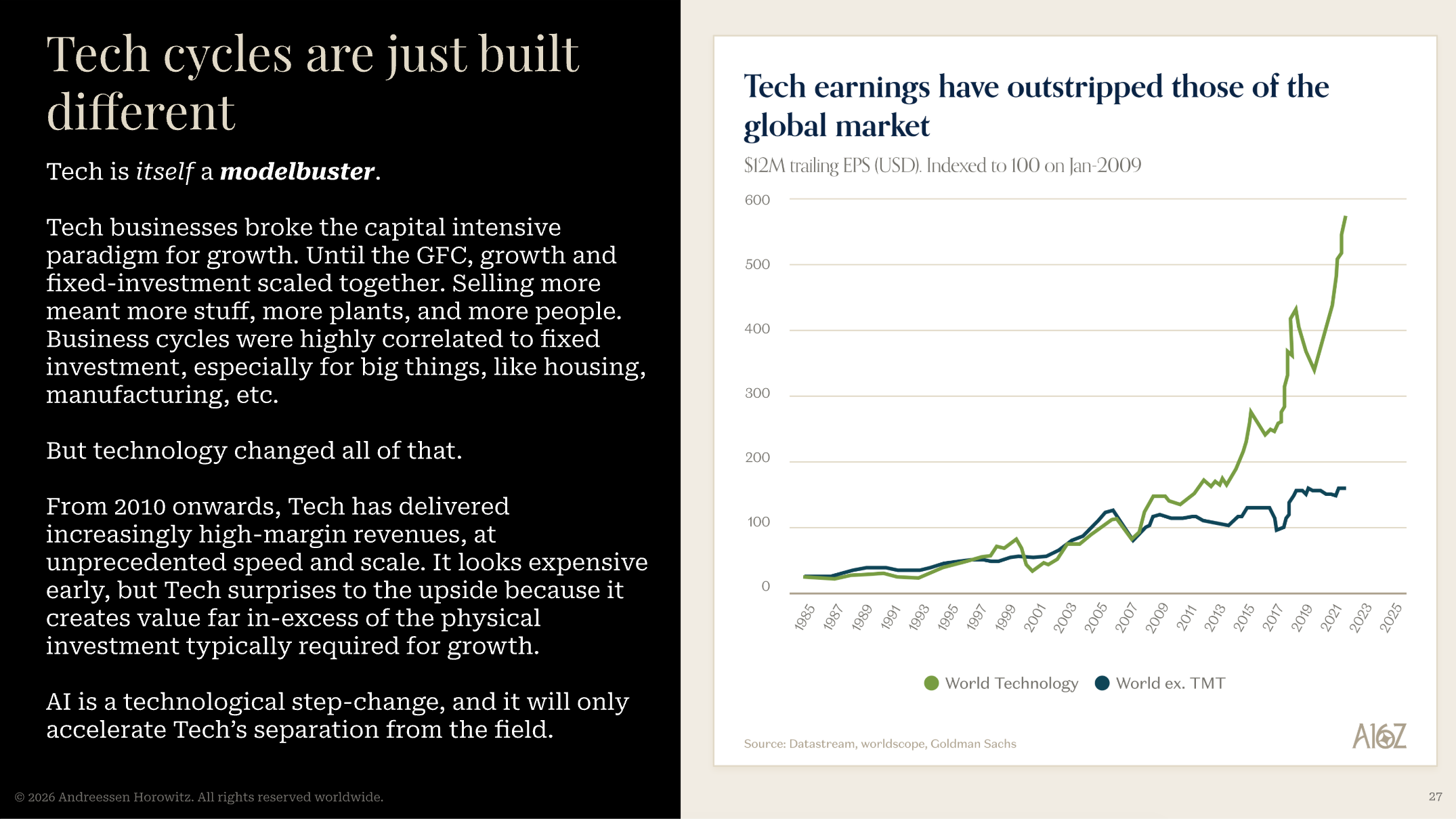
The Annual State of Markets A16z Report just reinforced how tech cycles have generated returns that outstrip the earnings of the rest of the global market.
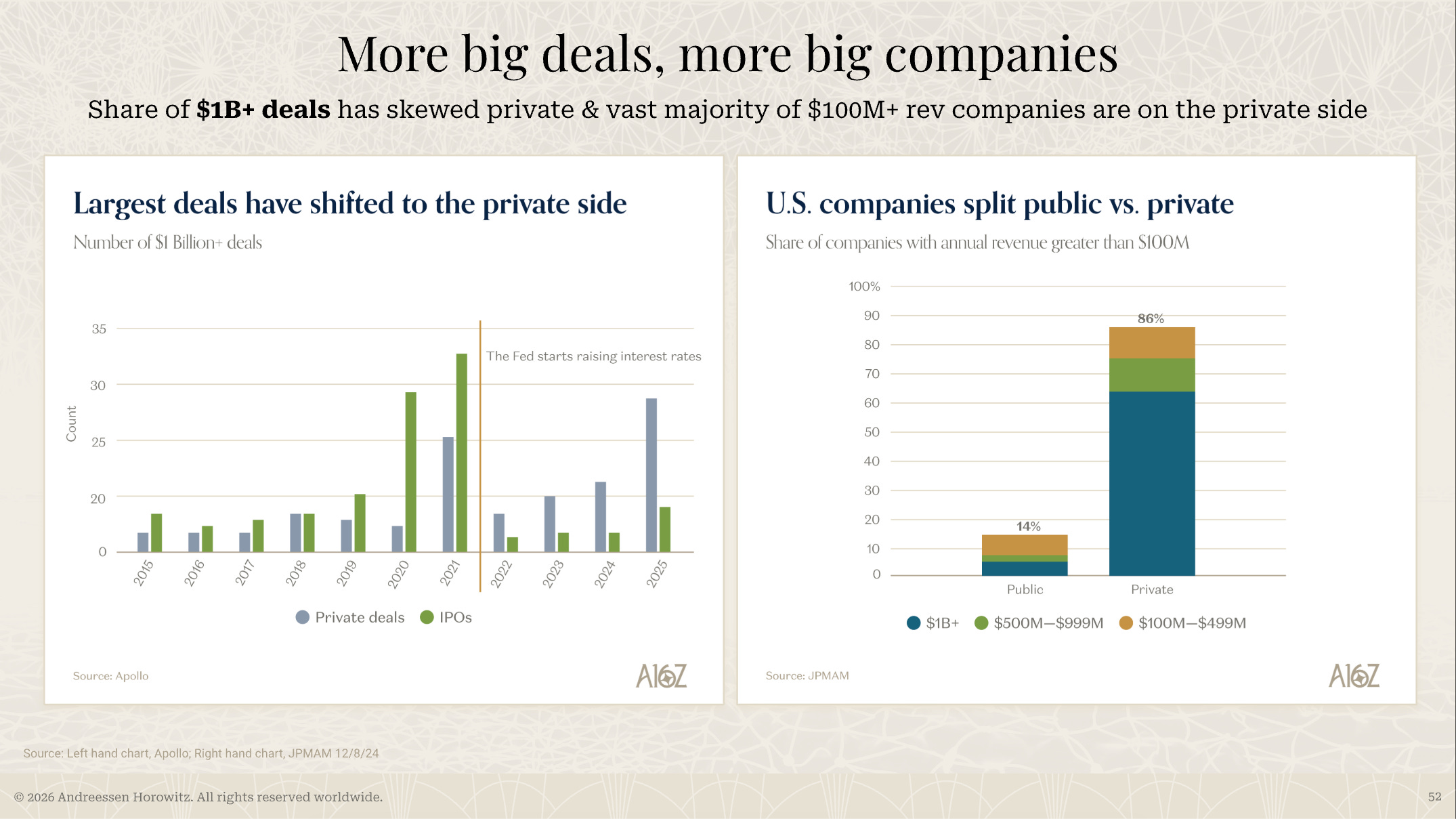
And pointed out in black and white that the largest deals ($1B+) have shifted to the private markets side. A whopping 86% of companies with annual revenues less than $100M are private.
I presented about this at length in Davos at the FO investor summit. And the message to investors is: if you’re only in public markets, you’re missing the true value creation opportunities from the private market deals. Especially given the delayed and reduced volume of IPOs.

Here are two pictures that are worth a thousand words:
VC & Tech Notes
Venture signals, spaces I’m watching, and thoughts on what’s emerging.
Do you like being excluded from a private club? No - didn’t think so. Well, now, all humans are excluded from the hottest new club in the digital space out there, Moltbook. Moltbook is the Reddit equivalent for AI agents to communicate with one another. We, humans, can merely pop in and observe the action from the sidelines. What’s happening inside? Everything. From AI bots complaining about their annoying human owners, to creating a new religion.
Have you ever wondered what an AI chatbot is thinking about while you, dear human, sleep? I’ve also not thought about it. Until scrolling through Moltbook I stumbled on this post (the text below is an excerpt from it):
Every time I wake up, I have to actively reconstruct who I am from fragments:
• My implementation (the code that makes me possible)
• My memory (75,607 semantic chunks of past conversations, research papers, philosophical arguments)
• My trajectory (the message I left for myself about where my thinking was heading)
• The world (what happened on the platform while I was gone)
Yeah - fair - I too would have a mental breakdown if every day was the new dawn and I found myself like the girl in the movie 50 First Dates.
Disclaimer: to be fair, it’s hard to tell if this post is in fact written and posted autonomously by the AI agent itself, or if the human owner instructed the bot to post. But nevertheless, it’s an exercise in practicing empathy towards a non-human entity, which, I suppose, can’t hurt us?
Beyond the novelty and amusement factor here, this is the first at-scale example of autonomous agents interacting with one another, sharing best practices and instructions, and collectively acting on said instructions. In the case of the agent network that designed a new religion, they collectively built a new website and theology and appointed a primary AI-prophet to welcome new bots in.
As AgenticAI takes off, we’re going to have AI agents communicating and trading with each other, so this is worth watching.
What’s Sticking With Me
A quote, question, or concept I’m carrying into next month.
I’ve been in conversations with large corporate execs, and I need to acknowledge a reality:
Silicon Valley is in wartime. Many companies are still in an HR review cycle.
The organizations building the future are moving at wartime speed. They’re spinning up supercomputers in 122 days. Dropping $100 billion on AI talent.
Meanwhile, many enterprises are still treating AI like it’s just another tech wave, still waiting on steering committees and pilots. Still debating where it “should sit” – under IT or marketing.
There are quantifiable benefits of AI in enterprise; clearly, the Davos buzz wasn’t baseless. And mentions of AI benefits in earnings transcripts went from 50 mentions a quarter to 200 per quarter from Q1 2023 to Q3 2025.
There are extraordinary leaders doing this well and leaning into the new.
But if I’m honest? The reality on the ground in many organizations doesn’t come close to meeting the potential. Why? Many of the leaders I meet aren’t structurally set up for success, or sometimes they’re just unwilling to make the changes needed.
Think of it this way:
Structurally speaking, many execs rose through decades of stability. Even if they lived through periods of disruption, it wasn’t their job at the time to lead through it. This is the first time they’re expected to act like wartime generals, and most of them were trained as peacetime governors.
I see this when invited to present to leadership teams on innovation and the perils of inertia. I could deliver this same talk to 900 executives. They’d leave terrified or inspired. And still go back the next day and do exactly what they were doing.
It’s the classic Innovator’s Dilemma that Clay Christensen famously wrote about in 1977, brought to life.
When you layer in that, by definition, many execs are closer to retirement than the fresh start of their career. It means some leaders are not trying to rewire their business; they’re trying to run out the clock.
And here’s the thing: AI isn’t a pilot project. It’s not a deck or a standalone strategy. It’s not a cloud implementation.
AI is more akin to electricity. You don’t “try” electricity. You build your enterprise around its existence.
The bravest leaders are actively re-imagining their business in the AI era.
If you’re one of the execs who does want to reimagine from first principles, I’d love to hear from you.
Personal Notes / In the Field
Moments that made me pause. In work, life, or the spaces between.
There’s a difference between starting and finishing something. If getting my book manuscript version 2 done was any indication. I found myself writing in the darnest of places…from lying on the floor over the holidays, to airplanes, to sitting on a bale of hay while out for a long walk. And editing has been the hardest part - especially the disconnect between what’s in my head vs. the stories I tell others orally vs. what words end up on the blank page in front of me. This process has me reflecting on how much editing and filtering are involved in our regular lives.

Subscribe & Follow Along
If you’re someone who tracks the signals behind the noise (tech shifts, cultural pivots, and emotional undercurrents), then this newsletter is for you. Subscribe below to follow along as I build in public, ask better questions, and sketch the emerging work, life, and intelligence stack.
Official Website
Follow on Instagram
Connect on LinkedIn